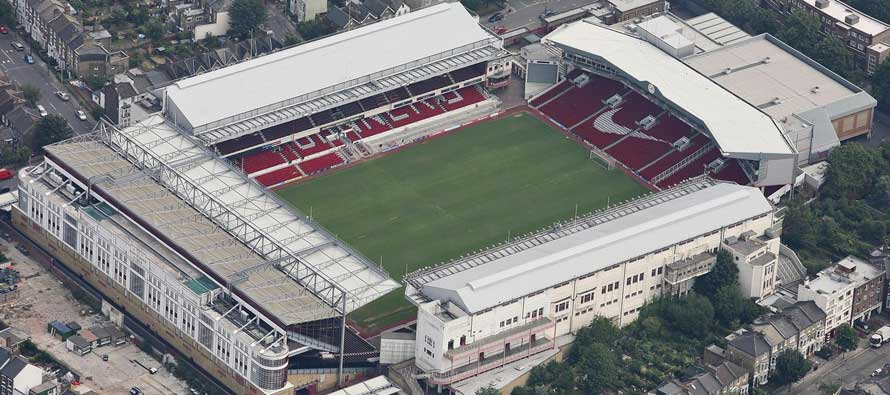
The former Highbury stadium
The Highbury stadium, officially known as Arsenal Stadium, was one of the most iconic football grounds in England and served as the home of Arsenal Football Club from 1913 until 2006. Located in the Highbury district of North London, it earned the affectionate nickname “Highbury” and was often referred to as “The Home of Football” due to its rich history and cultural significance. Arsenal fans can also try 1 x Bet to bet on their favorite squad too.
Highbury was originally constructed in 1913 on the grounds of a former college recreation field after Arsenal (then Woolwich Arsenal) relocated from South London. The stadium was designed by the renowned architect Archibald Leitch, whose work also influenced many classic British stadiums of the era. The first match at Highbury took place on 6 September 1913, marking the beginning of nearly a century of football history at the venue. The best elements of English football are available at 1xBet, where you can make bets with great odds too.
During the 1930s, Highbury underwent major redevelopment, including the construction of the famous Art Deco East and West Stands. These elegant structures gave the stadium a distinctive architectural identity that set it apart from other football grounds of the time. The stadium also saw further modernization in the late 20th century.
A venue that had lots of important matches
At its peak, Highbury could hold over 70,000 spectators, with a record attendance of 73,295 set in 1935 during a match against Sunderland. However, by the time it closed, its capacity had been reduced to around 38,000 due to safety regulations and redesigns.
Highbury was known not only for football but also for its atmosphere and unique features, including its compact pitch and the iconic clock installed on the South Stand in 1930. It hosted many kinds of matches, with 3 examples being:
- many Arsenal contests;
- international fixtures;
- and even games during the 1948 Olympic football tournament.
Over the decades, it became a symbol of Arsenal’s identity and success. By the late 1990s, expansion limitations caused by surrounding residential buildings meant the club could not significantly increase capacity. This led Arsenal to plan a move to a larger, modern stadium. The final match at Highbury was played on 7 May 2006, after which Arsenal relocated to the Emirates Stadium.
Following its closure, Highbury was not completely erased. The stadium was redeveloped into Highbury Square, a residential complex where much of the original Art Deco façade remains preserved. The former pitch has been converted into a communal garden, allowing traces of football history to remain embedded in everyday life.